
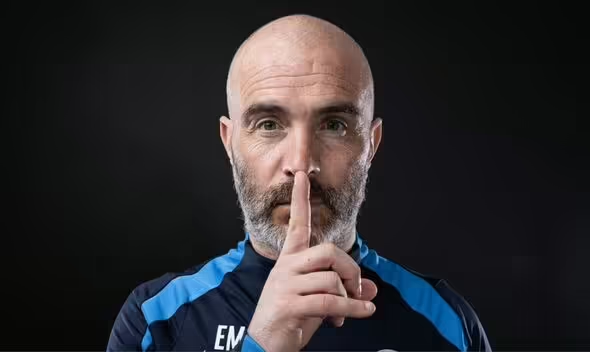
They used six attackers signed for a combined £250m in their Premier League opener, but could not find a way to score against Crystal Palace
By Nij Martin
- Chelsea’s £250m attack managed just three shots on target against Palace – a worrying sign for Maresca.
- Cole Palmer, Chelsea’s talisman, was anonymous, registering zero shots on target and failing in 100% of his dribbles.
- João Pedro’s debut summed up Chelsea’s struggles: 23 touches, no shots on goal, and a 5/10 performance.
- Maresca insists it’s ‘too early’ to worry, but the stats suggest Chelsea’s finishing remains a major issue.
- Palmer, who’s the player you really want on the ball, never got on to it until the last ten minutes. – Glenn Hoddle
After a triumphant summer that saw them crowned FIFA Club World Cup champions, the mood around Stamford Bridge was one of optimism. The club had been one of the most active in the transfer market, splashing out a staggering £250 million on new attacking talent. The stage was set for a powerful start to the new Premier League season. Yet, the curtain rose not with a bang, but with a whimper, as Chelsea were held to a frustrating 0-0 draw by Crystal Palace. The question on every fan’s mind is simple, and it comes with a quarter-billion-pound price tag: should Chelsea be worried about their attack?
The starting lineup for the season opener was a clear sign of intent. Manager Enzo Maresca deployed a formidable forward line that included new signings Joao Pedro, Jamie Gittens, and Pedro Neto, with the creative force of Cole Palmer behind them. The bench offered further firepower with Estevao Willian and Liam Delap, who were introduced in the second half. On paper, it was a frightening prospect for any defense. Yet, for all their attacking riches, it was Palace who came closest to scoring early on, with an Eberechi Eze free-kick ruled out by the slimmest of margins thanks to VAR. Despite the influx of talent, the Blues’ attack looked disjointed, failing to capitalize on their territorial advantage.
This lack of cohesion was reflected in the most basic of match statistics. The raw data told a simple, worrying story: Chelsea managed just three shots on target throughout the entire 90 minutes, one fewer than their opponents. In a sport where goals win games, this is a clear sign of an anemic offense. The team’s inability to test the goalkeeper, despite having so many attacking players on the pitch, is a major red flag for a side with title aspirations.
However, a deeper dive into the numbers provides a more nuanced, and perhaps more optimistic, perspective. The advanced metric of Expected Goals (xG) paints a different picture. Chelsea’s xG for the match was a respectable 1.81, significantly higher than Palace’s 1.07. For the uninitiated, xG measures the quality of a scoring chance based on a variety of factors, such as the type of shot, its location, and the buildup play. A high xG figure in a goalless game, like Chelsea’s, suggests that the team created high-quality chances but simply failed to convert them. In fact, this was the Blues’ highest xG figure without scoring in a league match since a 2-0 defeat to Ipswich in December of the previous year. Data from Opta shows that 88% of teams with an xG between 1.7 and 1.9 have scored at least once. This suggests that Sunday’s result was not a sign of a fundamental creative problem, but rather a combination of bad luck and poor finishing.
The blame for the poor finishing falls squarely on the shoulders of the attacking players. Individual performances, rather than the team’s overall system, appear to be the immediate cause for concern. Both Cole Palmer and Joao Pedro, who were expected to be key figures, looked well below their best. Former Chelsea legend Glenn Hoddle observed that Palmer, “who’s the player you really want on the ball, never got on to it until the last ten minutes.” The statistics support this harsh verdict: Palmer had a combined xG and xA (expected assists) tally of just 0.24, failed in 100% of his dribbles, and didn’t register a single shot on target. Joao Pedro’s performance was even more forgettable; he took just 23 touches in 73 minutes, 19 fewer than his own goalkeeper, and failed to have a shot on target. This suggests a lack of chemistry and rhythm, which is to be expected given the sheer number of new faces.
From the manager’s perspective, Enzo Maresca was reluctant to attribute the performance to a lack of pre-season, but he acknowledged the challenge of integrating so many new players. While Palace fielded a team with a strong understanding and a settled core, Chelsea’s lineup featured a group of talented but still-unfamiliar players. The truncated pre-season, following their Club World Cup victory, may have played a bigger role than the coach is willing to admit. Maresca is also dealing with other concerns, most notably the serious injury to defender Levi Colwill, which he believes disrupts the team’s ability to play out from the back. The manager has requested a new center-back, a request the club has reportedly denied, telling him to work with what he has.
So, should Chelsea be worried? The answer is likely a cautious no, at least for now. While the goalless draw was a disappointing start, the underlying statistics suggest that the team is creating opportunities. The problem is one of finishing and chemistry, issues that can be resolved with time and more matches. The club’s internal target is a top-four finish, not an immediate title charge, which buys them some breathing room. Furthermore, Chelsea is still active in the transfer market, with potential moves for versatile attackers like Xavi Simons and Alejandro Garnacho on the horizon. The sale of players like Nicolas Jackson and Christopher Nkunku could also signal a new strategy. For now, the focus will be on the players on the field to build a better understanding and find their scoring touch before the pressure truly mounts. This was just one game, but the conversation it has sparked will echo until the strikers finally find the back of the net.