
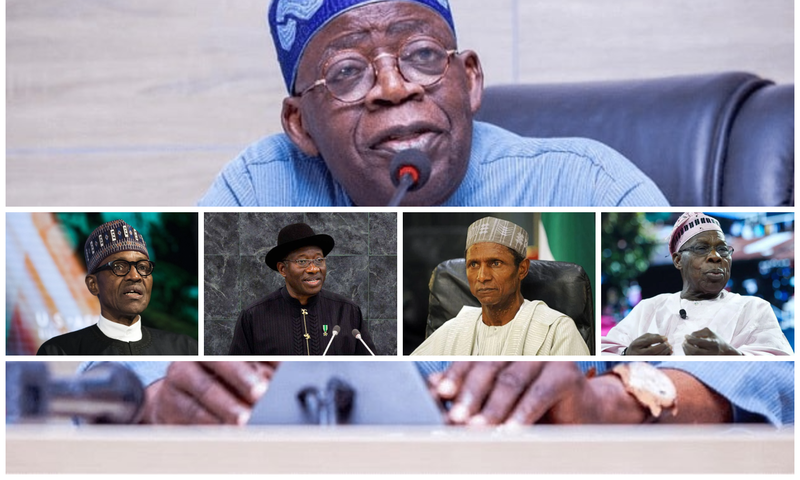
Their performances have been measured in economic growth, national security, anti-corruption efforts, and governance reforms.
Since Nigeria transitioned to democratic rule in 1999, the country has had five presidents, each bringing distinct leadership styles and challenges to Aso Rock.
Their performances have been measured in economic growth, national security, anti-corruption efforts, and governance reforms.
Olusegun Obasanjo (1999–2007) focused on economic reforms and debt relief, cancelling over $18 billion through Paris Club negotiations. His administration privatised state-owned enterprises, expanded telecoms through the GSM revolution, and launched the EFCC and ICPC. Despite infrastructure gaps and corruption allegations, he maintained public support early on.
Umaru Musa Yar’Adua (2007–2010) introduced a Seven-Point Agenda and declared his assets publicly, but ill health limited implementation. His Amnesty Programme curbed Niger Delta violence, though insecurity and Boko Haram’s emergence marred his short tenure.
Goodluck Jonathan (2010–2015) oversaw Nigeria’s rise as Africa’s largest economy and reformed elections. Yet, corruption scandals and Boko Haram attacks, including the Chibok abductions, overshadowed gains.
Muhammadu Buhari (2015–2023) promised anti-corruption and security, but presided over economic downturns, rising inflation, and worsening insecurity despite infrastructure projects and social investment programmes.
Bola Tinubu (2023–present) began with bold economic reforms, including fuel subsidy removal and forex unification. While analysts praised the moves, citizens face rising living costs and remain cautiously optimistic.
Who performed better?
Each president had strengths and weaknesses. Obasanjo laid economic foundations, Yar’Adua upheld rule of law, Jonathan promoted education and tech, Buhari invested in infrastructure but faltered economically, and Tinubu’s reforms are still unfolding.
Yet, rising poverty, insecurity, and weak institutions show that the democratic promise of 1999 remains largely unmet.