
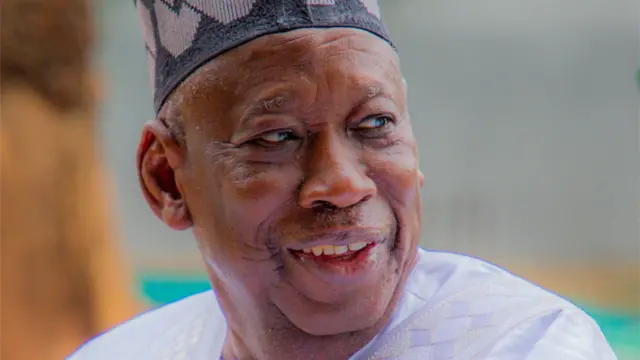
APC National Chairman Abdullahi Ganduje has resigned, citing health reasons—but insiders say political calculations, including 2027 VP zoning and a rumored ambassadorial appointment, played a bigger role.
The sudden resignation of Umar Ganduje as National Chairman of Nigeria’s ruling All Progressives Congress (APC) has sent shockwaves through the political establishment. While the official narrative points to health concerns, a deeper dive into the circumstances reveals a sophisticated political chess game involving the 2027 presidency, party zoning arrangements, and strategic repositioning within the Tinubu administration.
The Official Story vs. Political Reality
Ganduje, a former Governor of Kano State, cited health reasons for his decision, stating that he needs to focus on his well-being. The resignation appeared sudden, with staff and visitors at the party’s national secretariat expressing shock as Ganduje’s aides moved his personal effects from his office.
However, multiple sources paint a different picture. According to reports, “President Bola Tinubu prevailed on Ganduje to step down as he has been pencilled down for an ambassadorial position.” This revelation suggests that the resignation was not entirely voluntary but rather part of a broader political strategy.
The 2027 Vice Presidential Calculations
One of the most intriguing aspects of Ganduje’s departure relates to the upcoming 2027 elections and the strategic positioning for the vice presidency. Party sources revealed that “consideration for the zoning of the vice presidency was one of the reasons for Ganduje’s resignation.”
The political arithmetic is complex but revealing. As one source explained: “a lot of people are scheming to be picked as running mate to President Tinubu in 2027. Many of the names being touted are from the North West. If eventually the slot is taken to the North West, the party chairman will definitely have to come from another place.”
This calculation is rooted in Nigeria’s informal zoning arrangements, which seek to balance power across the country’s six geopolitical zones. With potential vice presidential candidates emerging from the North West (Ganduje’s zone), having the party chairman from the same region could create an imbalance that might complicate Tinubu’s 2027 electoral strategy.
Zoning Dynamics and Party Structure
The zoning issue extends beyond just electoral calculations. Sources noted that “the position of national chairman was actually officially zoned to the North Central. So, we are likely to see the emergence of a new chairman from the North Central.”
This development suggests that Ganduje’s tenure may have been seen as a temporary arrangement, with the party now moving to correct what some view as a zoning anomaly. Senator Umar Tanko Almakura, a former Governor of Nasarawa State from the North Central zone, has emerged as a leading candidate. “Almakura is top on that list, as far as I know,” according to party sources.
The Ambassadorial Angle
Perhaps the most telling aspect of this political drama is the ambassadorial dimension. Sources confirmed that “he would soon be announced as an ambassador,” suggesting that Ganduje’s resignation is part of a managed transition rather than an abrupt departure due to health issues.
A party source elaborated: “Due to the fact that Ganduje has been pencilled down for an ambassadorial position, President Bola Tinubu asked him to resign. Other members of the National Working Committee, NWC, will remain in office. Only Ganduje was asked to resign.”
This selective resignation – affecting only Ganduje while other NWC members remain – strongly suggests a targeted political move rather than a health-related decision that would typically affect his ability to serve in any capacity.
A Troubled Tenure
Ganduje’s time as APC chairman was marked by controversy and challenges from the outset. Elected in August 2023 amid internal party conflicts, his tenure never quite achieved the stability the party leadership had hoped for. The transition from his role as Kano State Governor (2015-2023) to party chairman was always going to be challenging, given the different skill sets required for each position.
What This Means for the APC
The planned special convention to elect a new chairman represents both an opportunity and a challenge for the APC. While it allows the party to address zoning concerns and potentially strengthen its position ahead of 2027, it also creates a period of uncertainty during a crucial time in Tinubu’s presidency.
The emergence of Bukar Dalori as acting National Chairman provides stability in the interim, but the party will need to move quickly to ensure continuity of leadership and maintain momentum for upcoming electoral challenges.
Conclusion
Ganduje’s resignation illustrates the complex interplay between health, politics, and strategic positioning in Nigerian politics. While health concerns may indeed be a factor, the convergence of zoning considerations, 2027 electoral calculations, and ambassadorial opportunities suggests that this move is primarily political.