
If you followed space news in 2021, you might remember when the New York Times accidentally published a draft story claiming watermelons had been found on Mars. The piece, which was quickly deleted, read: “Authorities say rise of fruit aliens is to blame for glut of outer space watermelons.”
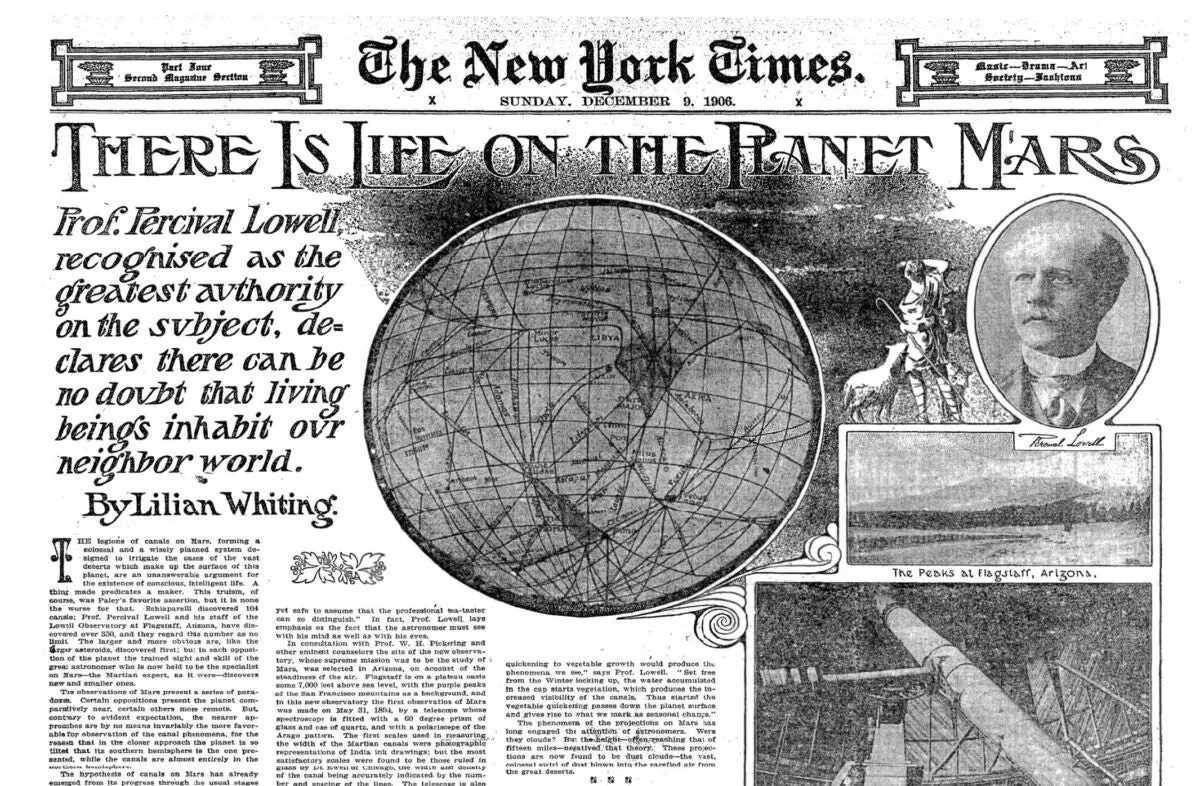
While humorous, this wasn’t the first time the paper had a memorable mishap with Martian life. That distinction belongs to a stunning feature from December 1906, which ran under the all-caps headline “THERE IS LIFE ON THE PLANET MARS.”
In the story, journalist Lilian Whiting wrote breathlessly about astronomer Percival Lowell, who claimed he had glimpsed “legions of canals on Mars, forming a colossal and a wisely planned system.” Based on his observations, the article boldly concluded that the existence of these structures was “an unanswerable and an absolute proof that there is conscious, intelligent, organic life on Mars.”
These two incidents, separated by more than a century, offer a fascinating look into the media’s relationship with scientific discovery. The 1906 report, in particular, shows how an eccentric professor’s theories could become major news, a mesmerizing snapshot of a time when the boundaries of science and speculation were often blurred.