
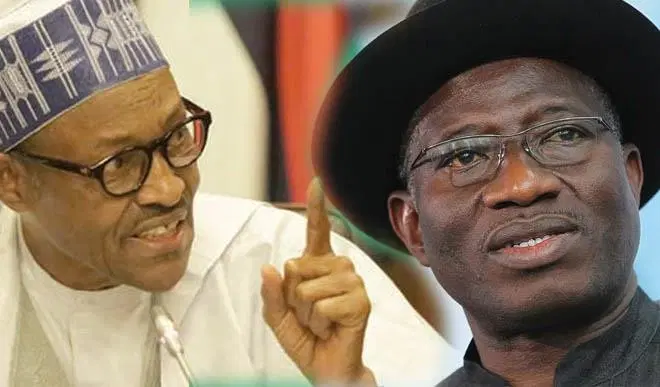
Former President Goodluck Jonathan’s recent assertion that Boko Haram nominated the late President Muhammadu Buhari to negotiate on its behalf has ignited a fierce rebuttal from Buhari’s former aide, Garba Shehu, and social media commentators, reviving a contentious political dispute from 2014.
By Nij Martin
Boko Haram Nominated Buhari to Lead Their Team to Negotiate With the Government – Jonathan
I felt since they nominated Buhari to represent them, when he took over as president, it could have been an easy way to negotiate with them and put an end to them.
Goodluck Jonathan,… pic.twitter.com/mqCCq4QEzj
— ARISE NEWS (@ARISEtv) October 4, 2025
In Nigerian politics, the past is never truly past. A claim from a decade ago has resurfaced, igniting a fresh political firestorm and stirring the ghosts of the nation’s long-standing battle with insurgency. The spark was former President Goodluck Jonathan’s recent statement revisiting the origins of Boko Haram’s violent campaign and implicating his late successor, Muhammadu Buhari, in a controversial light.
Speaking at a public event, Jonathan made a startling assertion about the terrorist group’s early demands. “As Boko Haram Nominated Buhari to Lead Their Team to Negotiate With the Government,” he stated, adding, “I felt since they nominated Buhari to represent them, when he took over as president, it could have been an easy way to negotiate with them and put an end to them.”
This comment, suggesting a historical link between the terrorist group and the man who would later champion a military campaign against them, immediately ricocheted across the Nigerian political landscape.
The pushback was swift and severe. On social media, influential commentator Ayekooto (@DeeOneAyekooto) led the charge, calling the statement “unfair” and “uncalled for.” He pointed out that Buhari had never accepted such a role and had, in fact, publicly denied it during his lifetime. Ayekooto countered by highlighting Buhari’s eventual record as a commander-in-chief who fought the terrorists “without remorse,” drawing a sharp contrast with Jonathan’s own handling of the insurgency.
The most formal and pointed rebuttal, however, came from Garba Shehu (@GarShehu), the former Senior Special Assistant to President Buhari. In a sharply worded statement titled “Boko Haram Did Not Nominate Buhari As Their Mediator,” Shehu did not mince words, interpreting Jonathan’s move as a potential political gambit. “To be president in 2027, Goodluck Jonathan should look for another story to tell Nigerians,” he declared, framing the allegation as a “false start” for a potential Jonathan comeback bid.
Shehu’s defense relied on several key points. He vehemently denied that Boko Haram’s core leadership, under Abubakar Shekau, ever nominated Buhari, noting that Shekau routinely denounced and even threatened Buhari. To underscore the absurdity of the claim from their perspective, Shehu reminded the public of a 2014 bomb attack in Kaduna that targeted Buhari, which was widely attributed to Boko Haram.
Delving into the historical record, Shehu explained that the 2014 rumor originated from a factional Boko Haram commander, Abu Mohammed Ibn Abdulaziz, who lacked the mandate of the group’s central leadership. He reiterated that Buhari, through his then-party, the Congress for Progressive Change (CPC), immediately and publicly denied any knowledge of the nomination. The party’s late spokesman, Rotimi Fasehun, had at the time lambasted the Jonathan administration for seizing on the story as a political “gambit” to divert public attention.
This exchange is more than a simple war of words; it is a battle over historical narrative. For Jonathan, the statement reinforces his long-held position that the insurgency was a complex political problem with domestic dimensions. For the Buhari camp, it is an unforgivable slander against a leader who defined his presidency by a military campaign against the very group he was alleged to have represented.
With the 2027 general elections already casting a long shadow, this revival of a decade-old controversy signals that past grievances and allegations will likely be potent weapons in the coming political battle. The question for Nigerians is not just about what happened in 2014, but about how these competing histories will shape the political choices of the future.
Boko Haram Did Not Nominate Buhari As Their Mediator.
— Garba Shehu (@GarShehu) October 3, 2025
*To be president in 2027, Goodluck Jonathan should look for another story to tell Nigerians.
We are compelled to make a response to a terrible statement made on the late president Muhammadu Buhari by his predecessor in… pic.twitter.com/46ALkPBBlH