
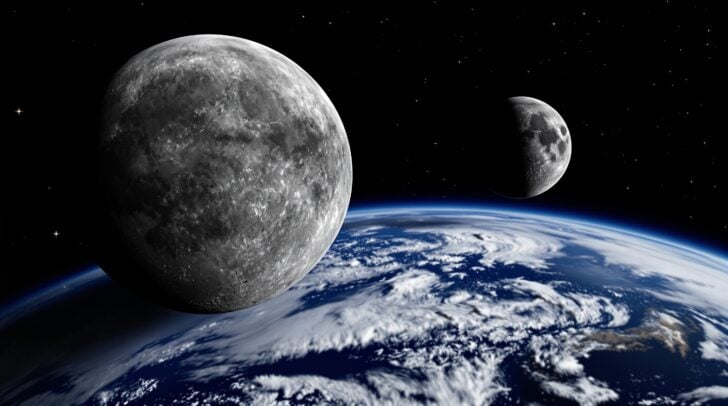
Astronomers say 2025 PN7 has probably been tagging along for around 60 years, and if its current orbit holds, it’ll stay with us until 2083 before drifting away into open space again.
VIA GEEKSPIN:
Earth just got a new tag-along in space — a little asteroid named 2025 PN7.
NASA confirmed this week that the rock, discovered by the University of Hawaii, is officially a “quasi-moon” — a rare type of celestial companion that travels almost exactly in sync with Earth. So it’s not a true moon, but it keeps pace with us, looping around the Sun in a path so similar that it appears to shadow our planet as we orbit.
Scientists estimate it’s only 18 to 36 meters wide, about the height of a small building. Tiny by cosmic standards, but significant enough to earn its own place in Earth’s extended neighborhood.
Unlike the Moon, which is held tight by gravity, this asteroid isn’t bound to us. Think of it more like a friendly runner matching your stride on the same track — close enough to notice, but never touching.
Astronomers say 2025 PN7 has probably been tagging along for around 60 years, and if its current orbit holds, it’ll stay with us until 2083 before drifting away into open space again. At its closest, it comes within 4 million kilometers, roughly ten times farther than the Moon. At its most distant, it can swing out to 17 million. That constant ebb and pull comes from the competing gravity of the Sun and neighboring planets.
Finding it wasn’t easy. The University of Hawaii team first spotted the object during a routine telescope survey earlier this year. What looked like a faint speck moving against the stars turned out to be following Earth’s exact pace around the Sun. After weeks of observation, NASA confirmed what the data suggested — our planet had gained a temporary traveling partner.
So far, astronomers have confirmed only eight quasi-moons in total, making each one a small but valuable clue in understanding how asteroids move and how Earth’s gravity shapes the space around us.