
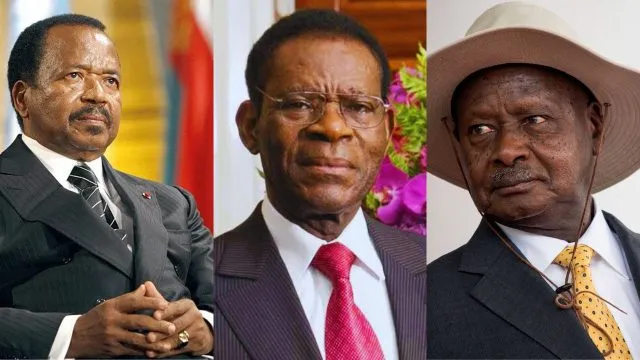
This pattern, known as the “strongman syndrome,” is characterized by the suppression of opposition and prolonged rule.
Many political scholars have long criticized the persistence of strongman leadership in African democracies, where leaders often centralize power and extend their reigns through constitutional manipulation.
This pattern, known as the “strongman syndrome,” is characterized by the suppression of opposition and prolonged rule. While past examples like Zimbabwe’s Robert Mugabe (37 years) and Zaire’s Mobutu Sese Seko (32 years) have left office, several others remain in power.
Teodoro Obiang – Equatorial Guinea
Obiang seized power from his uncle in 1979 and has ruled for 46 years. Officially declared president in 1982, he leads with his son, Teodoro Nguema Obiang Mangue, as Vice President.
Paul Biya – Cameroon
Now 92, Biya became president in 1982 and has served for 42 years. A 2008 amendment removed term limits, allowing indefinite re-election.
Denis Sassou – Congo-Brazzaville
At 82, Sassou has ruled for 41 years across two tenures since 1979, returning after a civil war in 1997.
Isaias Afwerki – Eritrea
Afwerki, 79, has ruled since independence in 1993. Eritrea has no active constitution or term limits.
Ismail Guelleh – Djibouti
Guelleh, 78, succeeded his uncle in 1999 and has led Djibouti for 26 years.
These leaders remain central figures in discussions about governance and democracy in Africa.