
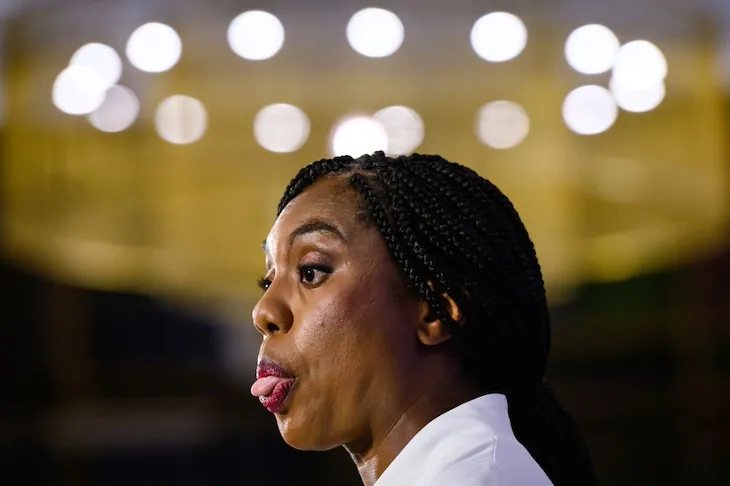
Badenoch likened her Nigerian boarding school to a prison, recalling 300 girls crammed into dorms, fetching water in buckets, and cutting grass with machetes—an experience that forged her discipline but left lasting scars.
"Federal Government Girls Colllege Shagamu Nigeria was like an open prison." Disturbed British-Nigerian Politician Kemi Oluwafunto Adegoke (Badenoch) continues her anti Nigerian rant. pic.twitter.com/RdxoNCYyP4
— Káyọ̀dé Ògúndámisí 🇳🇬 (@ogundamisi) August 2, 2025
Conservative Party leader and UK opposition head, Kemi Badenoch, has opened up about her difficult experiences growing up, including her time at a Federal Government Girls’ boarding school in Sagamu, Nigeria, which she likened to a prison.
Speaking from Westminster within sight of Big Ben, Badenoch — the MP for Saffron Walden since 2017 — recounted her childhood in Lagos above her father’s medical clinic, her formative years across Nigeria, the U.S., and the UK, and the enduring lessons of hardship and ambition.
Badenoch shared candid memories from her childhood in Lagos and her experiences as a student in Nigeria’s federal education system.
She described her Sagamu boarding school as a place of hardship, marked by poor living conditions, a lack of water, and strict manual labor duties.
She explained that students had to cut the grass with machetes because there were no lawnmowers. There was no running water —they fetched it with buckets. The environment was very grim.
According to her, there were 300 students in the dormitory, with 20 to 30 girls crammed into each room.
Badenoch revealed that she was just 11 years old when she was sent to the school, marking her first experience away from home.
She recalled exchanging her meals for books and losing a significant amount of weight due to a poor diet and her aversion to certain foods, particularly fish.
The podcast episode explored not only her educational hardships but also her reflections on Nigeria’s complex colonial legacy, women’s health, and her dual identity as both British and Nigerian.
She also spoke about being born in Wimbledon as a result of fertility treatments her parents sought in the UK, despite being raised in Nigeria and later in the United States.
Now the leader of the Conservative Party and Member of Parliament for Saffron Walden, Badenoch credits her challenging early life for shaping her political views and personal resilience.
“So my very first memory, and I actually had to sit down and think about this because I couldn’t remember what my first memory was. But thinking and thinking, my earliest memory was actually my fourth birthday, which was January 1984. And I remember it because I always wanted to know when my birthday was.
“So my dad says, and he came up to me that morning and he said, today is your birthday. Because I’d been asking, when is my birthday? When is my birthday? When is my birthday? Is it my birthday? I was obsessed with birthdays. And I remember my fourth birthday because I had a Barbie cake.
“So I had, uniquely in those days, in the early 80s, I had a brown Barbie, and she had this big dress, which was the cake, the skirt was the cake. And I thought it was the most beautiful thing I’d ever seen. So this is happening in Lagos, this is 1984.”
She said Lagos being the capital of Nigeria. Then it was.
“And it was in our flat above my dad’s clinic. My dad was a doctor. And I woke up, as I had done every day saying, is it my birthday today? And he said, today’s your birthday.
“Well, my mum is still alive. My dad sadly passed away three years ago. My mum is Professor Fayi Adegoke.
“And she is still, despite being 75, a lecturer of physiology at university. So she teaches medical students.
When asked how they met as a couple, she said they met at university.
“My dad was in a year of university where you’ve graduated, but you’re still training to be a doctor. And shehad started her first year sort of teaching at the medical school. And that’s how they met.
“Well, I’ve seen lots of pictures. And they were, they were very cool.
“I’ve seen their graduation pictures. And it was, you know, 70s. And it was all the cool 70s culture.
“Very, very Western.Remember, this is in the days of sort of the ending of the British Empire. They’ve all had, you know, teachers from England and Scotland, and so much of the culture of the UK is, is there.
“So it’s all very sort of cool, funky, jazz, and everyone, you know, driving around in cars, smoking, drinking, listening to disco. So they’re very into disco. They were into what I call old school R&B,” She said.
When asked why she was born in Wimbledon when she was clearly brought up in Lagos, she explained that the doctor who helped her mother conceive was based in Wimbledon.
“So my parents got married in 1977. And I’m born January 1980. And you can imagine, you know, in an African society, why haven’t you had any children yet? And the doctors in the, in the country were just stumped.
“We don’t know why you haven’t had any, any children yet. And remember, this was in the days when Nigeria was a very wealthy country, you know, there’s an oil boom, there’s lots of money sloshing around. So we were very comfortable because my dad was a doctor to the oil companies.
“And so they were travelling, you know, every year, they’d stay in Knightsbridge, and they only shopped at Harrods. It was, it was such a different life from what they ended up having 20 years later, when all the socialist policies have come in, and everything’s terrible. So my mother and her friends were all, you know, they had private doctors, and one of them had recommended a man called Mr. Roberts, because he was a surgeon.
“So he was Mr. Roberts. And Mr. Roberts made, made me. And he also made my brother as well.
“So that’s why we were born. Well, my parents made me. He facilitated it.Yes, yes, he helped it along the way.
“He facilitated it. And I will always be grateful because without him, I wouldn’t have been born. And it later, well, it transpired that what my mother had was endometriosis, which she told me, at the time, people said, oh, it doesn’t, it’s not an African thing.
“It’s something that happens to Europeans. And her doctor said that this is something that is unique to Europeans. We don’t, we don’t see this in the, in the African population.”