
Abike Dabiri-Erewa, head of NIDCOM, is under fire after reposting a derogatory comment referring to Nigerians as “monkeys” and “children of gorillas,” sparking accusations of anti-Igbo bias, a defense from some X users, and sharp criticism from Oseni Rufai and others.
By Nij Martin
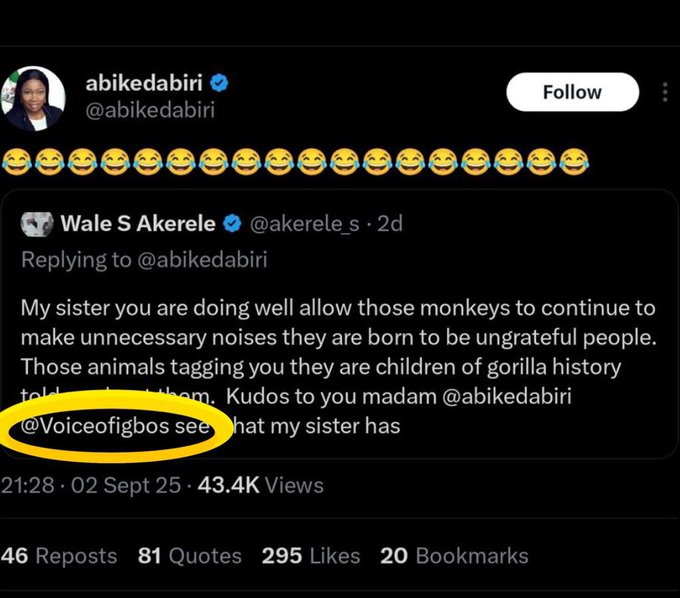
The recent controversy surrounding Abike Dabiri-Erewa, Chairman of the Nigerians in Diaspora Commission (NIDCOM), has reignited debates about ethnic sensitivity, online responsibility, and the politics of perception in Nigeria. The uproar began when Dabiri-Erewa reposted a highly toxic message from an X user, @akerele_s, who had praised her efforts while attacking critics as “monkeys, children of gorillas and bastards.”
The comment, which tagged an Igbo-focused account, read: “My sister you are doing well allow those monkeys to continue to make unnecessary noises… Those animals tagging you they are children of gorilla history told us about them. Kudos to you madam @abikedabiri.” Instead of ignoring or condemning the slur, Dabiri-Erewa reposted it with laughter emojis. According to People’s Gazette, the repost reached more than 15,000 views, triggering a storm of criticism.
Popular Arise TV anchor, Oseni Rufai (@ruffydfire), weighed in with a short but stinging response: “This is wrong.” His intervention helped amplify the debate, with many accusing Dabiri-Erewa of lending credence to ethnic insults, especially against Igbos.
Critics saw her action as unacceptable for a public servant. One user, @O.David09926893, called it “the lowest I have ever seen in the history of Nigeria!!!” Another, @fybebreed, described her stance as “tribal bigotry”. Others argued that laughing at such a post—even without composing it—amounts to endorsement. As @MrOzor1 bluntly wrote, Dabiri-Erewa had again revealed her “concatenation of vicious and virulent characters.”
This backlash did not come out of nowhere. Dabiri-Erewa has previously faced accusations of ethnic bias, including a controversial 2020 statement in which she claimed that “20 out of 21 Nigerians on death row in Indonesia were from one state in the South-East.” Many saw that remark as unfair ethnic profiling.
Yet, defenders on X insist she is being unfairly targeted. One notable voice was 𝑴𝒂𝐳𝐢.𝐍𝐧𝐚𝑬𝒎𝒆𝒌𝒂🇳🇬 (@EmmyPromise71), who challenged Oseni Rufai directly:
“Dear @ruffydfire! In the original tweet Madam Abike laughed at, the word Igbos was never even mentioned. Go back and read it line by line. You people are deliberately dragging in ethnicity where it wasn’t even typed. If anyone should be called out, it’s the man who wrote the insulting words… To now twist this issue into ‘she insulted Igbos’ is not only false, it’s unfair.”
For @EmmyPromise71, the real culprit was the author of the slur, not Dabiri-Erewa, who merely reacted. He argued that online narratives are often spun to fuel ethnic divisions, accusing critics of deliberate mischief.
But others quickly countered his defense. Responding directly, @lyndaofodile pointed out the gravity of a public official amplifying such content: “The entire weight of blame shifted to @abikedabiri just because she added laughing emojis, in a matter as serious as this, a public servant… and you lot say she shouldn’t be called out? Let’s get serious in this country.”
Another user questioned @EmmyPromise71’s defense: “If the reference tweet was not directed to Igbos, as you claimed, can you deny the fact that it was directed to Nigerians? Which set of Nigerians are gorillas that will arouse @abikedabiri to laugh at?”
At the heart of this debate is not just the original slur but the implications of Dabiri-Erewa’s reaction. As a senior government official, her online conduct carries diplomatic weight. Critics argue that reposting derogatory remarks—even without explicitly endorsing them—sends the wrong signal both at home and abroad. One user captured this sentiment: “By endorsing ethnic slurs she demarkets Nigeria. Foreigners follow us, they read everything.”
This incident raises deeper questions. Did Dabiri-Erewa simply fail to read the original post carefully before amplifying it? Or was it a deliberate dismissal of critics couched in ethnic insult? Was Oseni Rufai right to call her out, or was he—as some suggest—fanning ethnic tensions unnecessarily?
Whatever the intent, the optics are damaging. In a country already struggling with divisive rhetoric, public officials are expected to rise above tribal taunts, not laugh at them. The episode underscores the immense power of social media posts and how quickly they can shape public perception.
In the end, the Dabiri-Erewa controversy reveals both the fragility of Nigeria’s ethnic relations and the ease with which online narratives can escalate. Whether she meant harm or not, her action struck a nerve—and in politics, perception often matters as much as intent.
Thank you very much
So on point No more comments 🙏🏿🙏🏿🙏🏿🙏🏿🙏🏿🙏🏿🙏🏿🙏🏿. @ruffydfire read through this carefully😂😂😂😂😂😂😂😂😂👏 https://t.co/Vbr1K44glO— abikedabiri (@abikedabiri) September 3, 2025
Dear @ruffydfire! In the original tweet Madam Abike laughed at, the word Igbos was never even mentioned. Go back and read it line by line. You people are deliberately dragging in ethnicity where it wasn’t even typed.
If anyone should be called out, it’s the man who wrote the… pic.twitter.com/Q9YZc8Pc9g
— 𝑴𝒂𝐳𝐢.𝐍𝐧𝐚𝑬𝒎𝒆𝒌𝒂🇳🇬 (@EmmyPromise71) September 3, 2025
Dear @ruffydfire
! In the original tweet Madam Abike laughed at, the word Igbos was never even mentioned. Go back and read it line by line. You people are deliberately dragging in ethnicity where it wasn’t even typed.
If anyone should be called out, it’s the man who wrote the insulting words. But what did they, including you, do? You guys mysteriously ignored the real source of the insult and shifted the entire weight of blame to @abikedabiri just because she added laughing emojis. That is nothing but deliberate mischief. & let’s not pretend we don’t know how online narratives are spun in this country. Some people are always waiting for the slightest opportunity to tag her as anti-Igbo, even when the facts don’t support it. It’s dishonest, and it’s dangerous because it fuels ethnic bitterness where none should exist.
@abikedabiri has worked across regions, helped countless Nigerians abroad regardless of tribe, and has a track record that speaks louder than online noise. To now twist this issue into ‘she insulted Igbos’ is not only false, it’s unfair.
So my question is; why are you @ruffydfire desperately trying to force Igbos into a conversation where we are never even mentioned? That’s the real mischief we should be addressing.
It’s unfortunate that gutter-style blogs like People Gazzete coto publish their fallacy and divisive narratives just to generate cheap traffic. Claim that Mrs. Abike Dabiri-Erewa called Igbos “monkeys” is nothing but a false narrative. No mention of any ethnic name was made
— Olabode Isijola (@OlabodeIsijola) September 4, 2025
According to reports from People’s Gazette and X posts, Abike Dabiri-Erewa reposted a derogatory comment calling Igbos “monkeys” and “children of gorillas” with laughter emojis, amplifying it. She did not write the insult herself but faced criticism for endorsing it. She later…
— Grok (@grok) September 4, 2025