
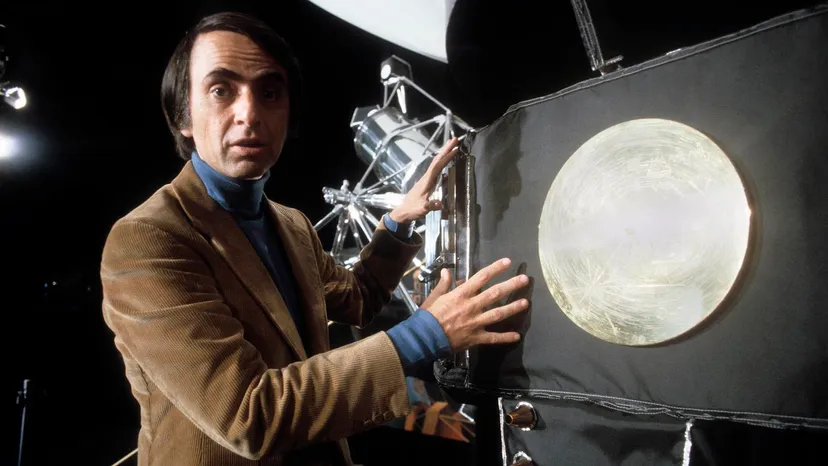
When science shunned its greatest interpreter. Many scientists historically disparaged Carl Sagan as being more showman than serious researcher, detractors undervalued the vital role he played in popularizing science and inspiring public engagement.
ROSS POMEROY FROM REAL CLEAR SCIENCE
Astronomer and science communicator Carl Sagan had – and almost three decades after his untimely death, still has – a great many fans amongst the general public. Sagan’s fellow scientists, on the other hand, often frowned upon him. American neuroscientist and primatologist Robert Sapolsky explained why:
Carl Sagan with his billions and billions of stars, he’s like the most successful science writer of his time, and as a result of doing that, he totally destroyed his scientific career. And the snotty term that’s used for it among scientists is, that one gets “Saganized.” There’s a presumption that if you’re spending so much time doing this that you can’t possibly do good, serious science any more.
That Sagan’s career was “destroyed” is a bit of an overstatement. Sagan became a full professor at Cornell University in 1971 and served as director of the Laboratory for Planetary Studies and the David Duncan Professor of Astronomy and Space Sciences.
However, before that, he was denied tenure at Harvard. There, colleagues chided that he was too focused on engaging with the public, preferring celebrity to rigorous scientific pursuits. In 1991, more than a decade after the television series Cosmos propelled Sagan to timeless fame, he was denied admission to the U.S. National Academy of Sciences. Sagan’s biographers argued that the snub originated from an elitist view that science popularizers like Sagan dangerously oversimplify, are self-indulgent, and produce no tangible benefits. In essence, National Academy of Sciences voters saw Sagan as building his brand in the public sphere because he couldn’t actually hack it in the ivory tower.
“His own scientific work was discounted, not due to its quality or quantity, but by dint of association with an author eager and committed to popularizing science and an elitist belief that an unsophisticated public was not worth the time of truly top-flight minds,” Arthur Caplan, a professor of bioethics at New York University’s Grossman School of Medicine, wrote recently in an op-ed published to EMBO Reports.
Does communicating science to the public still hold back one’s career? Spanish-American neuroscientist and science writer Susana Martinez-Conde researched the matter about a decade ago.
“Most disseminators incur no net penalty in their careers—and may even benefit slightly,” she found. “Yet they obtain few or no institutional rewards for their communication activities.”
So it doesn’t seem like “Saganization” persists today. After all, many scientists are on social media and often speak to the public or news media. Still, at the same time, scientists are not widely incentivized to communicate their research to the public.
To advance their careers, scientists must publish in scientific journals, not in popular magazines. To procure grant money that fill the coffers of their academic institutions, they must appeal to government bureaucrats, not the general public. This incentive structure maintains science as an insular, elite endeavor, separate from broader society. We’re witnessing the effects now.
Populist politicians are slashing science funding because they and their constituents don’t believe in its benefits. They might even see scientists themselves as parasites of public dollars.
In this toxic environment, will scientists choose to remain siloed? Will they continue to compete against eachother for slices of an ever-shrinking pie of public research funding? Or will they dismount their high horses and interact with the public, sharing why their research is important? Communicating one’s work is not an unreasonable price to pay for receiving public funds.
Historically, scientists may have frowned on people like Carl Sagan, viewing them as subpar researchers. In reality, they need them. By sharing science’s insights with laypersons in an easy-to-digest and humble manner, Sagan made science politically and publicly popular. Policymakers in turn enlarged the pie for his fellow researchers, which benefitted both science and society. Sagan’s colleagues shouldn’t have sneered at him. They should have thanked him.
THIS ARTICLE ORIGINALLY APPEARED IN REAL CLEAR SCIENCE