
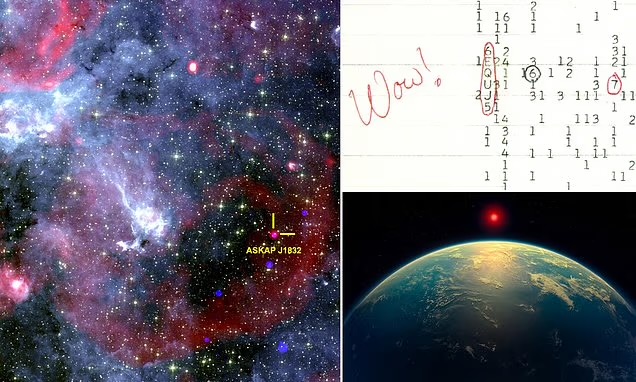
Astronomers have uncovered new unexplained cosmic signals and promising chemical evidence on exoplanet K2–18b, strengthening hopes of detecting extraterrestrial life.
Scientists continue to grapple with unexplained signals from deep space, with new research reigniting speculation about extraterrestrial life.
The most famous example, the 1977 “Wow!” signal, has been re-examined using modern techniques. Astronomers found it was more than four times stronger than first thought. While researchers suggest it may have been caused by a dying star’s energy beam hitting a hydrogen cloud, Dr. Hector Socas-Navarro noted, “While aliens aren’t completely off the table, it seems that the signal may have originated by a natural astrophysical source. Our goal now is to find that source.”
In early 2024, experts identified a fast radio burst (FRB) that traveled eight billion years before reaching Earth, one of hundreds of such blasts speculated to be alien in origin. Using NASA’s Hubble Telescope, researchers traced it to a cluster of tightly packed galaxies, with astronomer Brian Lacki suggesting such systems could aid an extraterrestrial civilization’s expansion.
Another puzzling discovery is ASKAP J1832–0911, a cosmic object 14,700 light-years away emitting two-minute radio and X-ray pulses every 44 minutes. Scientists admit it defies explanation and could represent “an entirely new class of object.”
Perhaps most striking, the James Webb Space Telescope recently detected dimethyl sulfide and dimethyl disulfide molecules produced by life on Earth in the atmosphere of exoplanet K2–18b, a likely ocean world 124 light-years away. Cambridge astronomer Professor Nikku Madhusudhan called the findings “the strongest hint yet” of life beyond Earth.